
£200k Lamborghini Seized Under New Antisocial Driving Laws
Essex Police seized a £200,000 Lamborghini after alleged extreme speeding. Discover how tougher antisocial driving laws can lead to vehicle seizure in the UK.

The Parking Ticket Pal Editorial Team
14 September 2026
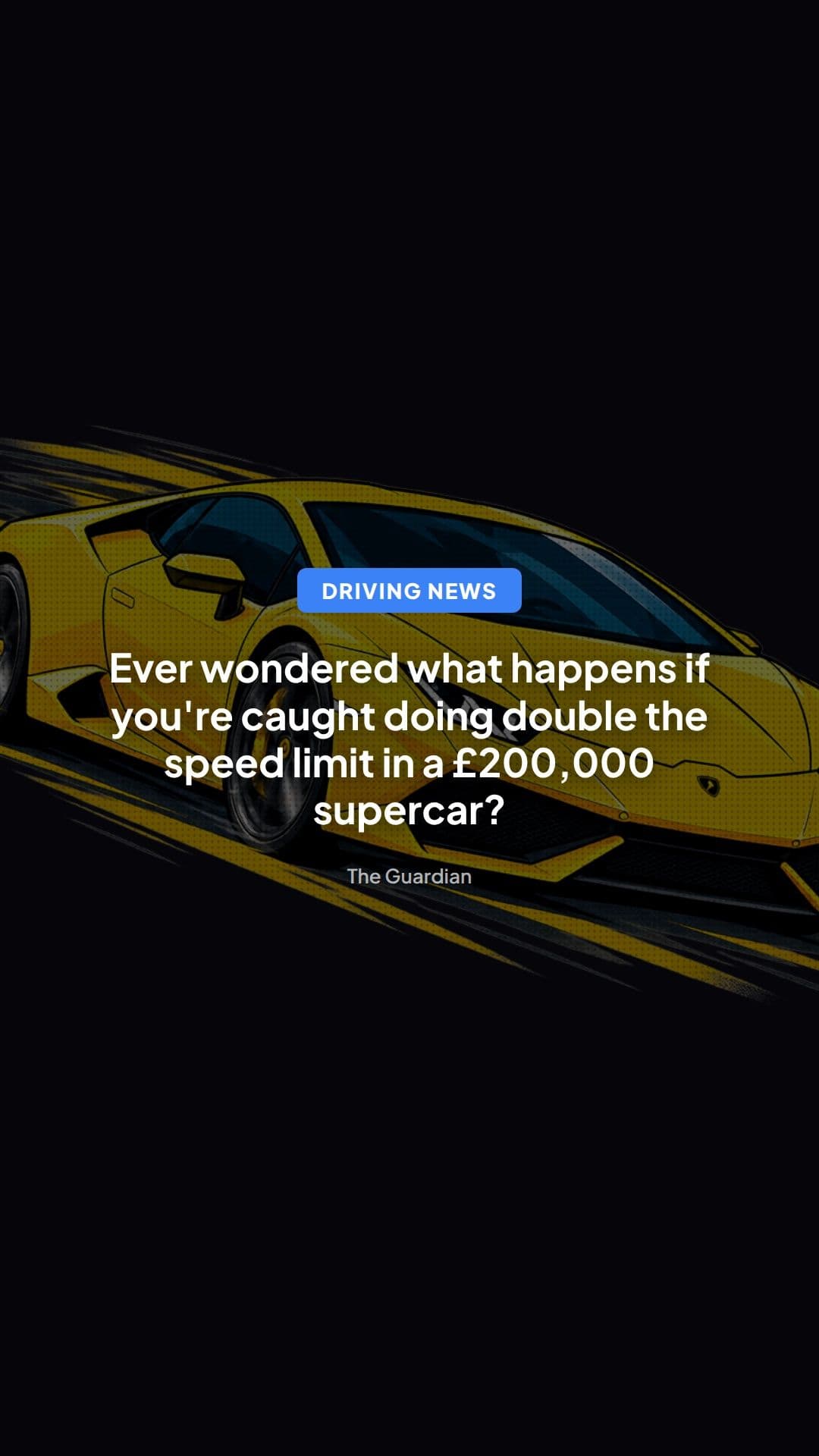
Police Seize £200k Lamborghini Under Tightened Antisocial Driving Laws
Imagine watching a quarter-of-a-million-pound supercar disappear onto the back of a police recovery truck, not because of an accident, but because officers decided enough was enough. That is precisely what happened when Essex Police seized a Lamborghini allegedly clocked at up to twice the local speed limit, using newly strengthened powers designed to crack down on dangerous and antisocial driving. It is a striking image, and a useful moment to unpack exactly what has changed in the law, why it matters far beyond one flashy car, and what it means for ordinary drivers who might never come close to owning a supercar.
What Happened
According to reporting from The Guardian, Essex Police seized the £200,000 Lamborghini after it was allegedly driven at speeds reaching double the posted limit. The force used tightened legislation targeting antisocial and dangerous driving, powers that have been sharpened in recent years specifically to make it easier and faster for police to take vehicles off the road when drivers behave recklessly.
The details released so far are limited, as is typical when a case may still be subject to further investigation or prosecution. But the headline fact is significant in itself: a high-value, high-performance car has been physically removed from its owner or driver by police, under legislation that previously made this kind of swift action considerably harder to achieve.
This is not an isolated stunt. It fits a clear pattern of forces across the country using seizure powers more assertively against supercars and modified vehicles associated with dangerous driving, illegal street racing, and so-called "cruising" meets, where groups gather to show off performance cars in ways that often spill into public roads with predictably alarming results.
Why It Matters
For years, one of the biggest frustrations for police dealing with antisocial driving was the legal requirement to warn a driver first before a vehicle could be seized under Section 59 of the Police Reform Act 2002. In practice, this meant an officer often had to have already given a warning, either to that driver personally or communicated in some other way, before they could act. Bad actors quickly learned to exploit this gap, effectively getting one free pass before any real consequence landed.
Tightened rules have moved to close that loophole, giving police more scope to seize vehicles being driven in a manner that causes alarm, distress, or annoyance to the public, without necessarily needing a prior warning to have been issued in every case. The logic is straightforward: if a car is being driven at double the speed limit through a town or village, waiting for a "second offence" before acting is a poor trade-off against public safety.
The symbolism of seizing a Lamborghini is not lost on anyone. Expensive performance cars are disproportionately associated, at least in public perception, with reckless driving, illegal meets, and dangerous overtakes. Seizing one sends a message that no amount of horsepower or resale value buys immunity from enforcement. It also removes, at least temporarily, a vehicle that by its very nature is capable of extreme speeds far beyond anything appropriate on a public road.
There is a wider road safety context too. Speed remains one of the biggest contributing factors in fatal and serious collisions on UK roads. Cases involving illegal street racing, nitrous-assisted modifications, and extreme speeds have led to tragic outcomes and increasingly severe sentences, as covered in our coverage of a fatal crash involving nitrous oxide and extreme speed. Against that backdrop, police forces facing pressure to demonstrate they are taking dangerous driving seriously have a strong incentive to use every tool available, including seizure of the vehicle itself.
The Legal Angle
It is worth being precise about the powers actually in play here, because "seizure" is not a single simple concept in UK law and different provisions apply in different circumstances.
Section 59, Police Reform Act 2002 is the classic antisocial driving power. It allows police to seize a vehicle being used in a manner that causes, or is likely to cause, alarm, distress, or annoyance, covering things like careless or inconsiderate driving on and off-road, including on land the driver has no permission to be on. Historically this required either a prior warning to the individual concerned or evidence that a warning had previously been given regarding that vehicle. Recent legislative changes have aimed to reduce reliance on this prior-warning requirement, giving officers more immediate discretion to act.
Section 165A, Road Traffic Act 1988 gives police separate powers to seize vehicles where the driver has no insurance or no valid licence, a power frequently used but distinct from the antisocial driving provisions.
Once a vehicle is seized, the registered keeper typically has a limited window, often around 21 days, to produce proof of insurance, a valid licence, and pay any recovery and storage fees before the vehicle can be claimed back. If nobody comes forward, or the paperwork cannot be produced, the vehicle can ultimately be disposed of, whether sold or scrapped. Storage and recovery charges can mount quickly, and for a car of Lamborghini-level value, secure storage is not cheap, adding real financial pressure on top of the embarrassment of the seizure itself.
It is also worth noting that seizure does not automatically equal conviction. The driver alleged to have been speeding will still need to go through the usual criminal justice process for any speeding or dangerous driving charge, which could range from a fixed penalty and points, through to a court summons for dangerous driving depending on the circumstances and speed involved. Seizure of the car is a separate, more immediate administrative and enforcement action, sitting alongside whatever criminal proceedings may follow. For context on how courts and prosecutors weigh up serious speeding and dangerous driving allegations, our piece on a dangerous driving sentence increased after a fatal crash gives a sense of how seriously these cases are now being treated when they go before a judge.
What Drivers Should Know
You do not need to own a supercar for this story to be relevant. The principles apply just as much to a modest hatchback as they do to a six-figure Lamborghini.
- Speeding is speeding, whatever you drive. Vehicle value has no bearing on how the law treats excessive speed. A car allegedly doing double the limit is treated as a serious road safety risk regardless of badge or price tag.
- Seizure powers are broader than many drivers realise. It is not just uninsured or unlicensed driving that can result in your car being taken away. Antisocial or dangerous use of a vehicle, including on public roads, can now trigger seizure more readily than in the past.
- Getting your car back costs money and time. Recovery and storage fees apply from the moment a vehicle is seized, and they accumulate daily. Even if you are ultimately not charged with an offence, you may still face a bill simply to release the vehicle.
- Ignorance of a "warning" is no longer a reliable shield. Drivers who previously assumed they needed a documented prior warning before police could seize their car should not rely on that assumption under the tightened rules.
- This sits alongside, not instead of, penalty points and prosecution. A seized car does not mean the matter ends there. Points, fines, or a court appearance for dangerous driving can still follow, and in serious cases a driving ban is a realistic outcome.
If you are ever contacted by police in relation to a seizure, or receive notice that your vehicle has been taken, it is sensible to seek professional advice quickly, particularly if you believe the seizure was carried out incorrectly or without proper grounds. These cases can turn on technical points of procedure, and challenging a seizure informally rarely works as well as understanding your formal rights of appeal or representation.
Looking Ahead
Expect to see more stories like this one. Essex Police's action is part of a broader national push to use tightened antisocial driving powers more assertively, particularly against high-profile, high-value vehicles that attract social media attention and public complaints when driven irresponsibly. Forces have clearly recognised that seizing an eye-catching supercar generates deterrent value well beyond the individual case, sending a visible signal to anyone tempted to treat public roads as a racetrack.
For everyday drivers, the direction of travel is clear. Enforcement against dangerous and antisocial driving is getting faster, less encumbered by procedural hurdles, and increasingly willing to hit offenders where it hurts most, their vehicle itself. Whether you drive a Lamborghini or a decade-old family car, the safest position remains the simplest one: stick to the limit, drive to the conditions, and remember that the cost of getting caught out now extends well beyond a fine and points on your licence.
Written by
The Parking Ticket Pal Editorial Team
Source-checked parking guidance
Ready to Challenge Your Ticket?
Let our AI analyse your PCN and generate a professional appeal letter in minutes.
Start Free Appeal