
£100 Parking Charge for Wheelchair Stop: Your Rights
A £100 private parking charge after a two-minute wheelchair stop in New Quay has sparked anger. Learn about appeals, Equality Act rights and next steps.

The Parking Ticket Pal Editorial Team
24 October 2026
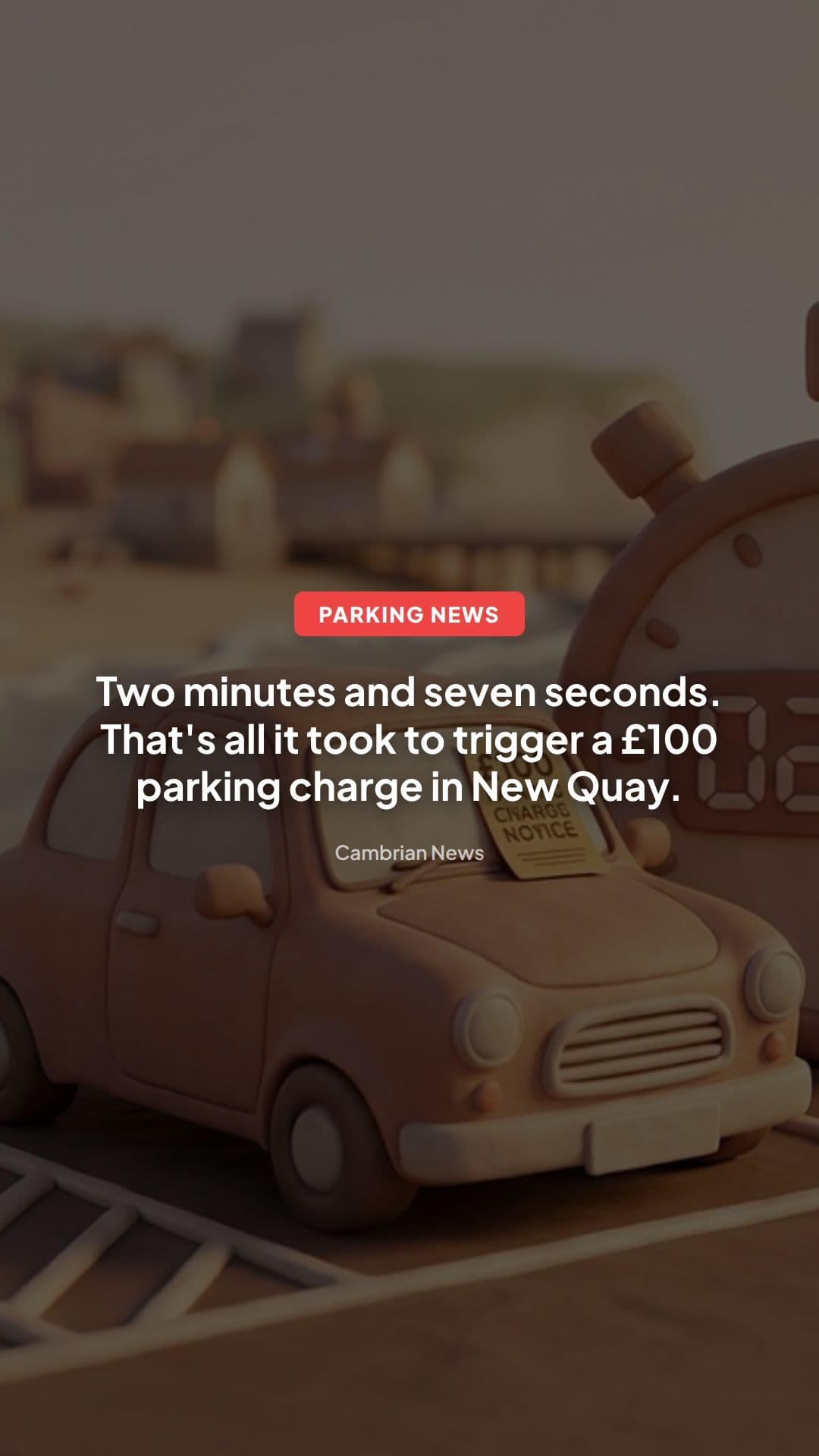
Two Minutes, One Wheelchair, £100: What the New Quay Parking Charge Row Tells Us
Picture the scene. You pull up somewhere you shouldn't linger, because passengers who need help are waiting. You open the boot, get the wheelchair out, and make sure everyone is safely settled. It takes a little over two minutes. A few days later, a letter arrives demanding £100.
That is what happened to a driver in New Quay, Ceredigion, according to a report in the Cambrian News. She stopped to help disabled passengers and load a wheelchair, received a private parking charge, and had her appeal rejected. The decision has prompted criticism of the parking operator and plenty of local anger.
Cases like this are uncomfortable because they sit where parking enforcement meets basic decency. They also raise useful questions about how private parking charges work, what "parking" actually means, and where disability rights fit in.
What happened
The details published so far are fairly simple. A driver stopped for just over two minutes. The purpose was practical and unavoidable: helping disabled passengers and loading a wheelchair. A £100 parking charge followed. She appealed and was turned down, and the rejection is what turned a private dispute into a public row.
It is worth being clear about what we do not know. The report, as summarised, does not tell us exactly what the signs said, how the stop was recorded, or the precise reasoning the operator gave for rejecting the appeal. Anyone commenting on the case should be careful not to fill those gaps with assumptions. What we can do is look at the principles that normally apply to a situation like this.
Why this story resonates
Most drivers accept that car parks need rules. Nobody wants a seaside car park blocked by people who have abandoned their vehicles for the day. But a charge of £100 for a stop lasting little more than two minutes, made to help disabled people, feels disconnected from the purpose of those rules.
Several things make this kind of case sting.
The scale of the penalty. £100 is a large sum for a stop of this length. It also arrives as a demand with a deadline, and often with the prospect of rising costs if it is ignored.
The nature of the stop. Helping a passenger in and out of a vehicle is the sort of thing most people would call a pick-up or drop-off, not parking in the ordinary sense. Yet many private sites make no formal distinction.
The power imbalance. A private operator sets the terms, issues the charge, and, at the first stage, decides the appeal. A rejected first appeal can feel like the end of the road. It is not, but that is how it lands emotionally.
The setting. Coastal towns like New Quay depend on visitors, many of them older people or families with accessibility needs. Parking enforcement in these places often attracts strong local feeling, and complaints about heavy-handedness tend to travel quickly.
The legal angle: how private parking charges actually work
It helps to understand that a private parking charge is not a fine. Fines are issued by councils, police, or other public bodies under statute. A private charge is the operator's claim that you breached the terms of a contract, or caused a loss, by using their land. By stopping on the site, the argument goes, you accepted the terms on the signs.
Contract law and the Beavis case
The leading authority is ParkingEye Ltd v Beavis [2015] UKSC 67. The Supreme Court held that a £85 charge for overstaying a free parking limit was not an unenforceable penalty, because the operator had a legitimate interest in managing the car park and the charge was not extravagant. The case is often cited as a green light for private charges, but it turned on its particular facts: clear, prominent signage and a charge that served a legitimate purpose. It did not say every charge will be valid in every circumstance.
What counts as "parking"?
This is where a short stop becomes interesting. Whether a contract was formed, and what its terms were, depends on the signs and the wording. Some signs prohibit "parking". Others say "no stopping". Others set a maximum stay or require payment on entry. A sign that only restricts parking may not obviously cover a brief stop to help someone out of a vehicle, while a "no stopping" sign is more direct. The wording matters a great deal, and so does whether it was visible and legible at the point of entry.
The Equality Act 2010
The most important legal angle in a story like this is arguably the Equality Act 2010. Businesses and organisations that provide services to the public, which can include operators managing car parks, have duties relating to disabled people. These include a duty to consider reasonable adjustments, and the duty is anticipatory, meaning it is not only triggered once someone complains.
Whether the Act applies to a given case is fact-specific. Questions include who the disabled person was, what service was being provided, whether the driver was the disabled person or a companion, and what adjustment would have been reasonable. Appeal bodies for private parking are not courts and may treat such arguments differently, and a court claim is a very different step from an appeal. This is an area where general information only goes so far, and anyone with a real dispute should look at official guidance, such as that from the Equality and Human Rights Commission, or seek advice.
Keeper liability and the Protection of Freedoms Act 2012
If a charge is sent to the registered keeper rather than the driver, the operator relies on Schedule 4 of the Protection of Freedoms Act 2012 (POFA). This sets out strict requirements about what the notices must say and when they must be sent. If the driver has been identified, as appears to be the case in New Quay, these rules matter less, but they are a useful reminder that operators have to follow a defined process.
The appeals process and where it can lead
A rejected appeal is not necessarily the final word. Most private parking operators belong to one of two trade bodies, the British Parking Association (BPA) or the International Parking Community (IPC), and each has its own independent appeals service. If you appeal to the operator and are rejected, the rejection letter should explain how to take the matter further, and there are usually time limits, commonly around 28 days. Check the letter carefully, as deadlines vary.
Independent appeals can consider issues such as:
- whether the signage was clear and prominent
- whether the operator complied with the relevant code of practice
- whether a "grace" or "consideration" period applied
- whether any mitigating or exceptional circumstances should have led to cancellation
The industry codes of practice have long recognised the idea of a short period in which a driver is not expected to have "parked" in a meaningful sense, but the details differ between codes and have been revised over time. Anyone relying on this point should check the current wording of the relevant code instead of working from memory.
Importantly, an independent appeals body is not a court. If a charge is still unpaid, an operator may eventually pursue a claim in the county court. Court action brings its own risks and costs and is where official advice, from Citizens Advice for example, is worth seeking.
What drivers should know: practical takeaways
This is general information, not advice on any individual case. With that in mind, here are some things worth keeping in mind whenever you stop on private land.
1. Check whether you are on private or public land. In many coastal towns, a car park, a forecourt, and a roadside can all look similar. The rules, the enforcers, and your options differ. A council penalty notice follows a statutory process, while a private charge is a contractual claim.
2. Read the signs before you stop, if safe to do so. Look for the wording at the entrance and by the bays. "No parking", "no stopping", "pay on entry", and "maximum stay" are very different instructions. Photograph them if you can. Note the position of the signs and whether they were legible.
3. Keep evidence of why you stopped. If you are helping someone with mobility needs, small details can matter later, such as photos showing where you stopped, the time, and the surrounding area. Contemporaneous notes, such as a message sent at the time, can help describe what happened. Copies of any relevant paperwork, including evidence that a passenger has a disability, may be useful if you choose to appeal. Only share what you are comfortable sharing.
4. Respond within the deadlines. Charges usually come with a stated period for payment or appeal. Missing a deadline can reduce your options. If in doubt, read the notice carefully and check the relevant code.
5. Appeal in a clear, factual way. An appeal that sets out what happened, how long it took, why it was necessary, and which points of the signage or code you rely on is usually more effective than one built on anger. Stay calm, be concise, and keep copies.
6. Know about the independent stage. If your first appeal is rejected, the next step may be an independent appeals service linked to the operator's trade body. Look for the details in the rejection letter. For more on how these stages work, our guides on POPLA appeals and on private parking charges cover the process in depth.
7. Consider asking for support. If a disability-related issue is central to your case, organisations such as Citizens Advice, the Equality Advisory Support Service, and disability charities can offer guidance on your rights and next steps.
Looking ahead: will the rules change?
The New Quay case lands at a time when private parking regulation in the UK is under scrutiny. The Parking (Code of Practice) Act 2019 provided for a single statutory code of practice for private parking operators in England, Scotland, and Wales, with the aim of making the system fairer and more consistent. The government has consulted on proposals including a cap on the level of charges and a minimum grace period. The detail, timing, and exact figures have been subject to change, so anyone wanting the current position should check official government publications, not rely on commentary. Our recent posts on the proposed £100 cap and 10 minute grace period set out what has been put forward.
If a statutory code does bring in clearer grace periods and better handling of vulnerable drivers, it could change how cases like this are treated. A recognised short period before a charge can be issued, along with stronger obligations to consider disability-related circumstances, would address much of the frustration this story has caused. Until then, drivers are largely dependent on the existing industry codes, the wording of the signs, and the discretion of operators.
There is also a wider lesson for the industry. Enforcement that is technically defensible but looks disproportionate tends to damage public trust. Operators that handle exceptional circumstances sensibly, and visibly, are likely to face fewer headlines and fewer disputes.
The bottom line
A two-minute stop to help disabled passengers should not, in a sensible system, produce a £100 demand. Whether the charge in New Quay was valid under the contract, the signs, and the relevant codes is a separate question, and one the report as summarised does not fully answer. What the story does show is how quickly a routine act of assistance can turn into a dispute with real financial stakes.
For drivers, the practical message is to understand where you are stopping, keep evidence, meet deadlines, and use the independent appeals process if needed. For regulators and operators, it is a reminder that fairness is not only about legal defensibility. It is also about whether a charge makes sense to the people receiving it.
This article is general information about UK parking and motoring rules and is not legal advice. If you are dealing with a parking charge, check the official guidance for your situation or seek professional advice.
Written by
The Parking Ticket Pal Editorial Team
Source-checked parking guidance
Ready to Challenge Your Ticket?
Let our AI analyse your PCN and generate a professional appeal letter in minutes.
Start Free Appeal